Rulers: Norfolk Island: History
Norfolk Island
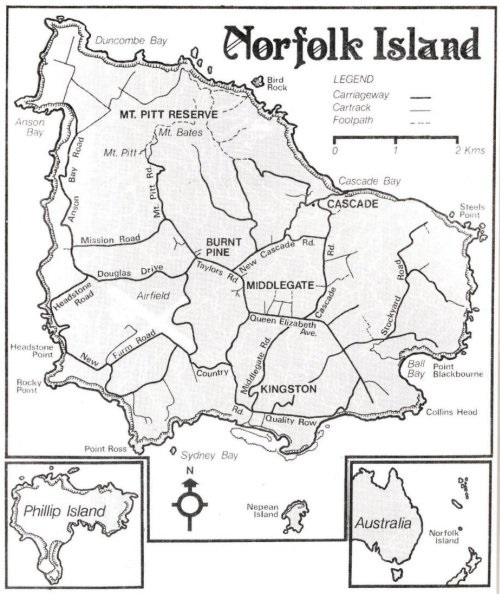
Norfolk Island (including the smaller Phillip Island, 6 km to the south, and the even smaller Nepean Island, just 800 m to the south; both uninhabited) lies in the Pacific Ocean, between Australia and New Zealand. The distance to Sydney is about 1,700 km. The nearest neighbour, however, is New Caledonia, about 900 km to the north.
3,200,000 years ago: Norfolk Island is formed from lava erupting from an unknown event. The island is reduced to about 1/3 of its original size by erosion and weathering since then. Phillip Island is also of volcanic origin, but not Nepean Island, which is Late Pleistocene (126,000-12,000 years ago) limestone formed from wind-blown sand dunes.
1000-1400: In this period, at least one Eastern Polynesian group arrives on Norfolk Island, probably from the Cook or Society Islands or the North Island of New Zealand.
1400-1774: Possibly another Polynesian group arrives in this period, most likely from the South Island of New Zealand. Bananas are established in the present-day Kingston area by one of the first or second groups. Besides bananas (which are propagated only by hand), stone patu (axe heads) and canoe remains provide evidence of this pre-European human habitation.
Oct. 10, 1774: The English navigator Captain James Cook on the Resolution discovers the uninhabited island, names it for Mary Howard, Duchess of Norfolk, and proclaims it a British possession. Cook, describing the island as "a Paradise," enthusiastically reports that flax and giant pines grow abundantly there, providing material for ships. This is not borne out later because the pine timber is not suitable and transforming the flax into fabric and ropes is too difficult.
1785: French explorer Jean-François de Galaup, comte de La Pérouse, sails round the island but is not able to land - declaring the island "fit [only] for angels and eagles."
April 25, 1787: King George III instructs Captain Arthur Phillip: "Norfolk Island... being represented as a spot which may hereafter become useful, you are, as soon as circumstances will admit of it, to send a small establishment thither to secure the same to us, and prevent it being occupied by the subjects of any other European power."
March 6, 1788: Norfolk Island becomes the second British possession in the Pacific when it is claimed by the Australian colony of New South Wales (itself only established six weeks before). Lt. Philip Gidley King selected 22 people including 15 convicts to establish a settlement on Norfolk Island. Of the motley 759 persons who arrived with the First Fleet in Botany Bay, Australia, in January, these were selected as "the best of a bad lot." Six women convicts were chosen as those "whose characters stood fairest" and they were joined by nine male convicts and seven free men, their ages ranging from 16 to 72. The oldest, Richard Widdicombe, had been a farmer. He was convicted for "stealing one wooden winch and other goods, value four guineas," and was sentenced to seven years transportation. The youngest, Charles McLennan, was convicted when he was only 14 years of age and given seven years for "stealing a bladder purse, value one penny, one gold half-guinea, one half-crown, and six pennies." They left Sydney in HMS Supply on February 14 and (after discovering and naming Lord Howe Island on the way) land at what King names Sydney Bay, on the southern side of Norfolk Island, on March 6 (after a whole week of circling the island to find a place to anchor, during which King named Anson Bay, on the western side, after the member of Parliament for Lichfield, England). Six weeks after the landing, King (though by the standards of his time a relatively benign man) metes out his first punishment. Seaman John Batchelor, accused of stealing rum from King's own tent, receives three dozen lashes. Undeterred by being forced to watch the flogging of Batchelor, young Charles McLennan goes on a rum search and finds it in Surgeon Jamieson's tent. For this he receives 50 lashes. He just recently turned 16. The commandant loses no time in taking to himself a mistress, choosing an ex-dressmaker named Ann Inett who, for stealing a few clothes, had been sentenced to death by hanging, but reprieved and given seven years transportation. Encouraged by King's example, Edward Garth, a young man who also had his death sentence reprieved, pairs off with Susannah Gough, an ex-prostitute, while Nathaniel Lucas, a carpenter, settles down with 25-years-old Olivia Gasgoin whose crime was rather more serious than the others - "stealing with force and arms." In a very short time, all three ladies are pregnant and a new generation is beginning, a people whose origins are in the South Pacific. In a matter of only months, King's convicts construct a road from Sydney Bay (the settlement there comes to be known as Kingstown, later written Kingston) to Anson Bay, via Mount Pitt, and make much headway in clearing ground, felling trees, and sawing wood for a variety of buildings. He locates a good source of limestone at the western end of Turtle Bay (today known as Emily) and thus has the ingredient for mortar and plaster.
Oct. 2, 1788: The vessel Golden Grove sails from Sydney to Norfolk Island with the second group of 42 settlers (including 32 convicts).
January 1789: An attempted mutiny is prevented by an informer. Convict William Francis supposedly hatched a plot to take the island. In March he is sent to Sydney on the Supply.
Jan. 8, 1789: Ann Inett presents Commandant King with the settlement's first child, which he proudly names "Norfolk."
April 1789: King can report that food crops are very promising - groves of Rio banana trees, orange trees, sugarcane, rice, wheat and barley, pumpkins, potatoes, turnips, artichokes, lettuce, onions, leeks, celery, and parsley.
March 19, 1790: HMS Sirius, the flagship of the First Fleet, bringing supplies to Norfolk Island (as well as Maj. Robert Ross to replace King as lieutenant governor, as the title has become), wrecks on the reef at Sydney Bay, Norfolk Island. Fortunately there is no loss of life, but the food supply becomes difficult. As the spectre of starvation hovers over Norfolk, salvation arrives overnight when hundreds of thousands of petrels appear from the sky, migrating back to their nesting burrows on Mount Pitt. The starving islanders call them "birds of providence," believing they were sent by God to save them. For months, these fishy-tasting but life-preserving birds are slaughtered at the rate of about 2,000 a day (from April 10 to July 10 the keeper of the public stores records a total of 171,362; the last of the birds disappear around 1800). But while life is assured, life style deteriorates as, with many more convicts to deal with, the commandants take more and more recourse to the cat o' nine tails. This lead-weighted lash usually breaks the flesh on the fourth blow. If a man faints on the triangle before he has received his prescribed number of lashes, he is taken down and the remainder saved for a time when he is able to bear them. If the flogger does not wield the lash with appropriate zeal, he himself will be flogged.
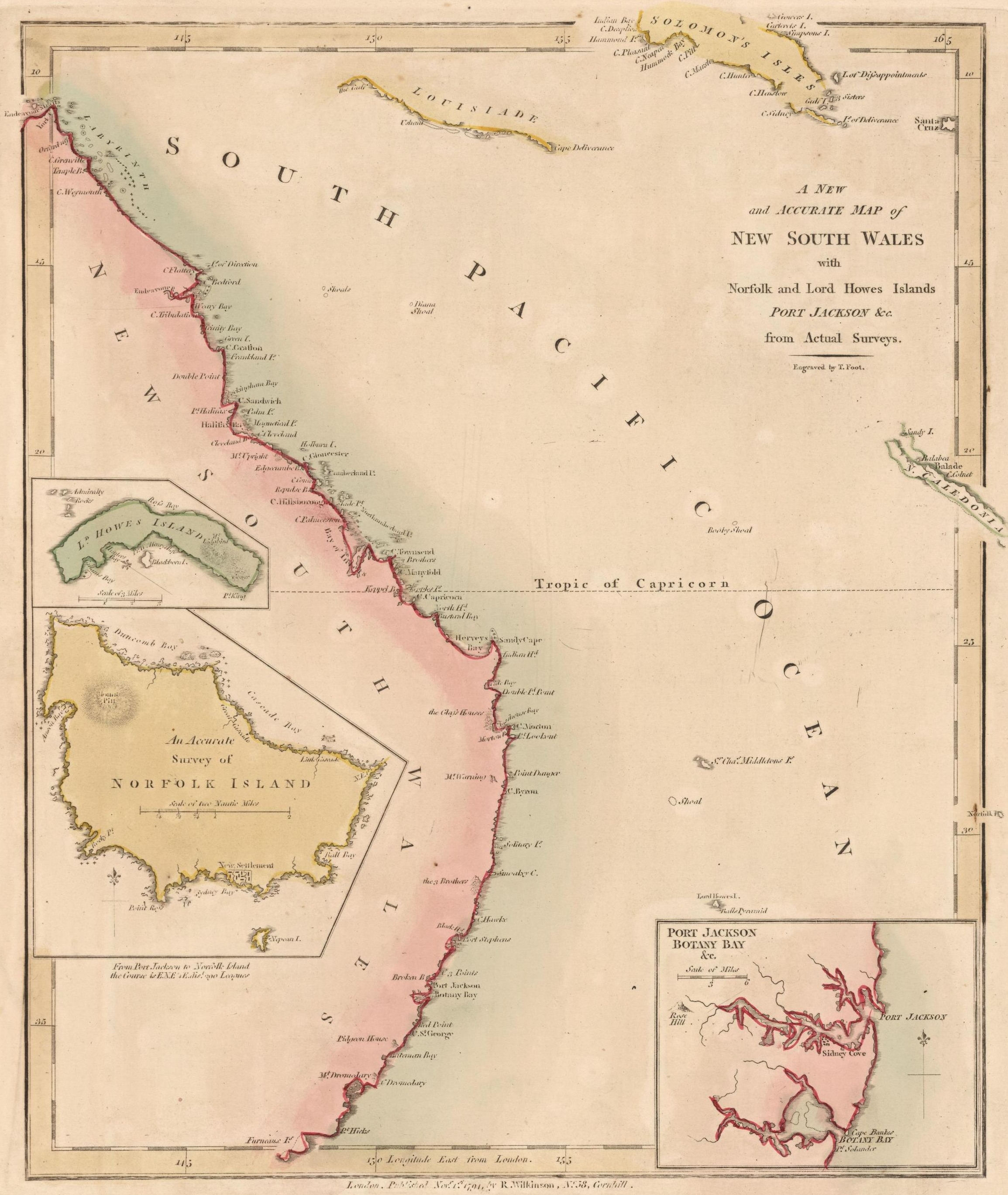
1791 map of New South Wales, including Norfolk Island (off the right border and in inset). |
Nov. 4, 1791: King returns to Norfolk on HMS Gorgon with an English wife (having left Ann Inett and his two sons at Port Jackson, New South Wales, before leaving for England to report on the potential of the island) and Rev. Richard Johnson, the only chaplain of New South Wales. Johnson gets to work immediately holding a church service and baptizing the 30 or so children who have been born on the island.
September 1792: Population: 1,115, including guards and soldiers, women and children, free settlers, time-expired convicts, and 303 serving convicts.
April 1793: Two Maori men from New Zealand, named Tuki and Huru, are taken involuntarily to Norfolk Island when King wants his convicts to learn flax weaving. While they cannot help with that (because flax handling is traditionally the taught skill of women), they are well treated, but witnessing the cruelties to the convicts makes them despondent and they repeatedly ask to go home and even threaten suicide. In November King accompanies them back to New Zealand on the Britannia.
Jan. 18, 1794: Unrest among soldiers which was brewing for some time erupts in a brawl. King personally arrests one who was waving a bayonet around, and the next day he decides to disarm the troops to prevent a mutiny. A few weeks later he sends ten he considers as ringleaders to Sydney for trial.
September 1796: King, suffering from ill health, departs for England on a leave of absence. He nominally remains lieutenant governor and plans to return, leaving the island in command of Capt. John Townson.
July 1798: The governor of New South Wales, John Hunter, in reply to a petition from Norfolk settlers who complained that the government store gave preference to produce such as pork which came from the farms of the military officers (worked by convict labour), issues an order saying: "It is with much astonishment and displeasure that the governor has been informed of the very unwarrantable association entered into by the settlers and other persons upon Norfolk Island, and which he understands they have in a most seditious manner termed The Fraternal Society of Norfolk Island. No complaints or grievance whatever can be admitted as a sufficient reason for a step so pregnant with danger to the tranquility of the inhabitants of that island, nor can there be any shadow of an excuse for such an association..."
November 1799: The premature departure of Townson obliges Capt. Thomas Rowley as the senior officer present to take charge of the island's affairs.
June 26, 1800: King, who has been appointed governor of New South Wales, appoints Maj. Joseph Foveaux as acting lieutenant governor of Norfolk Island. In 1801 Foveaux's position is confirmed by the British government.
1804: Population: 1,104.
Sept. 9, 1804: Foveaux leaves for England on a prolonged sick leave. John Piper becomes commandant. By this time the British government has decided to abandon the island and transfer the inhabitants to Port Dalrymple, Van Diemen's Land (Tasmania).
March 1, 1805: A number of soldiers and 50 convicts leave on the Investigator for Port Dalrymple.
December 1807: Foveaux is ordered to return to Norfolk and resume command if sufficient inhabitants remain there. On arrival in New South Wales in July 1808, however, he finds George Johnston in power after an insurrection against Governor William Bligh, and he himself takes over the government (until January 1809), never proceeding to Norfolk.
Jan. 25, 1810: Tankerville Alexander Crane is appointed commandant.
End of March 1810: The population has fallen to 117.
Jan. 20 and Feb. 18, 1813: The Lady Nelson and Minstrel, respectively, carry off nearly all the military personnel and their families and most of the settlers, who are taken to Van Diemen's Land (where they leave their trace in the name of the town of New Norfolk and the region of Norfolk Plains). The last official in charge is William Hutchinson, superintendent.
February 1814: The penal settlement is closed, most of the wooden buildings destroyed (lest the French find them attractive enough to occupy), and the island is abandoned, the last group taking off in the brig Kangaroo.
June 6, 1825: Captain Richard Turton reoccupies the island as a settlement for "worst felons." According to Governor George Arthur of Van Diemen's Land, "When prisoners are sent to Norfolk Island, they should on no account be permitted to return. Transportation thither should be considered as the ultimate limit and a punishment short only of death." This settlement period is renowned for the number of convict uprisings, deaths, and harsh treatments inflicted by some of the commandants. Judge Sir Roger Therry writes of a group of convicts sent to Sydney to give evidence at the trial of one of their brethren: "Their sunken glazed eyes, deadly pale faces, hollow fleshless cheeks, and once manly limbs, shrivelled and withered up as if by premature old age, created horror among those in court. There was not one of the six who had not undergone from time to time a thousand lashes each and more. They looked less like human beings than the shadows of gnomes who had risen from their sepulchral abode. What man was or ever could be reclaimed under such a system as this?" Following one uprising, a priest writes: "I have to record the most heart-rending scene that I ever witnessed. The turnkey unlocked the cell door and... then came forth a yellow exhalation, the produce of the bodies of the men confined therein. I announced to them who were reprieved from death and which of them were to die. It is a literal fact that each man who heard his reprieve wept bitterly, and each man who heard his condemnation of death went down on his knees and, with dry eyes, thanked God they were to be delivered from this horrid place." In this same period, however, the island is significantly developed: a collection of beautiful Georgian sandstone buildings reflecting the military nature of the settlement are built, many surviving into the 21st century; roads and wharf facilities are constructed; and crops of various kinds planted and farm stock built up.
September 1826: In a convict uprising, 4 lives are lost; 2 leaders are later executed in Sydney.
February 1829: Capt. James Thomas Morisset is appointed commandant, having actively sought the position. He arrives on the island on May 26. But he is soon disenchanted with the appointment and in August 1831 asks to be placed in "some civil situation" in New South Wales, which is rejected.
Jan. 1, 1834: Capt. Foster Fyans, known as "Flogger Fyans," becomes acting commandant due to the illness of Morisset, who on January 8 notifies his intention to retire from his position.
Jan. 15, 1834: An uprising, three months in the planning, involves more than 130 convicts, but is quickly suppressed, leaving five convicts dead. Fyans selects about 100 convicts to be flogged in the short term, while the trial of 55 men is held a few months later, of whom 29 are sentenced to death, with 13 actually executed.
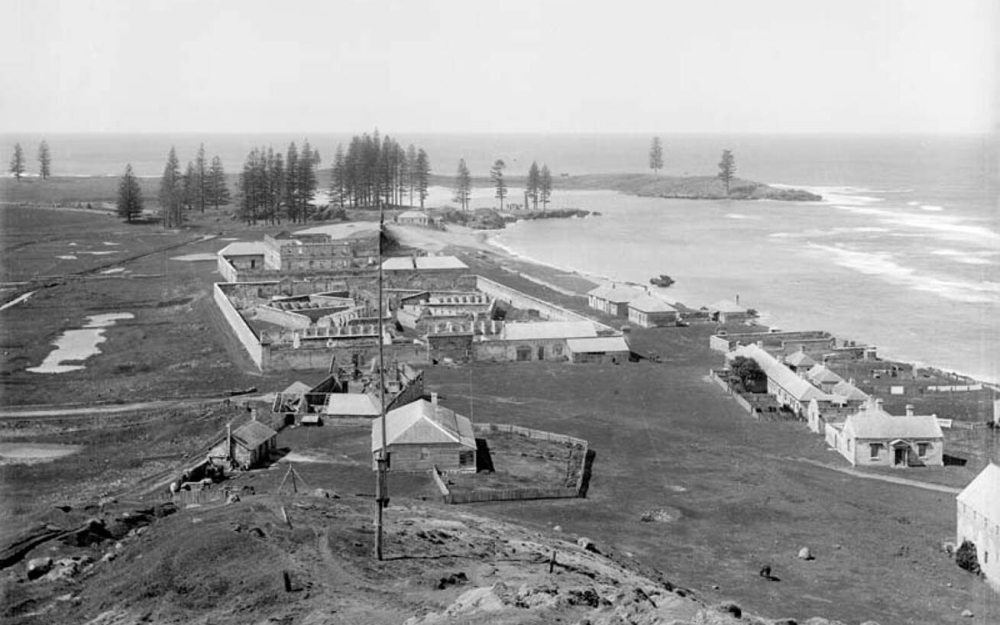
Photograph (c. 1900) of the New Gaol Compound at Kingston, showing the pentagonal wings in which the prisoners were housed. |
1837: Building of the New Gaol begins.
March 6, 1840: Capt. Alexander Maconochie arrives to become commandant. His period provides an exception to the unrelenting horror. He is a prison reformer whose innovative prison systems, treatment of offenders, and building designs are well ahead of the ideas of the day.
June 21, 1842: A group of 12 convicts seizes the government supply vessel Governor Phillip several miles offshore, but is defeated with the loss of several lives on both sides. Four of them are subsequently executed.
March 11, 1843: Governor Sir George Gipps makes an unannounced visit. He reports: "Notwithstanding that my arrival at Norfolk Island was altogether unexpected, I found good order everywhere to prevail, and the demeanour of the prisoners to be respectful and quiet."
Jan. 22, 1844: A Court of Petty Sessions is established at Norfolk.
Feb. 8, 1844: Joseph Childs arrives from England to replace Maconochie, whose system has been deemed a failure by the colonial secretary.
Sept. 29, 1844: Under Letters Patent of Oct. 24, 1843, Norfolk Island ceases to belong to New South Wales and is made part of Van Diemen's Land.
1846: The island is reported as having 5,228 sheep.
July 1, 1846: The confiscation of items of cutlery and cooking utensils belonging to the convicts leads to the "Cooking Pot Riot" led by a former bushranger, William Westwood, known as Jackey Jackey. It results in the murder of four officials. In October, 12 convicts including Westwood are found guilty and hanged.
1847: The New Gaol is completed.
1852: The Catholic bishop of Hobart, Dr. Robert Wilson, checking on conditions in Norfolk, sees 218 men out of 270 in chains at a church service, besides frequent flogging. He writes a report advising the abandonment of the island.
1853: The British government says it has been decided to break up the penal establishment at Norfolk Island. Lord Howe Island has been considered as an alternative site for a penal settlement, but this does not come to pass.
May 1855: The settlement closes with only a caretaker (Thomas Samuel Stewart), his wife, and some trusted prisoners staying until 1856 to hand over the island to the population of Pitcairn Island, descendants of the mutineers from the HMS Bounty, who are to be resettled on Norfolk Island as Pitcairn has become overpopulated.
June 8, 1856: 195 people arrive on the Morayshire, which left Pitcairn on May 3, to form the first free settlement on Norfolk Island. On board were originally 194 Pitcairners (40 men, 47 women, 54 boys, 53 girls) who were joined by a baby (Reuben Denison Christian) born on May 9. They included 48 Quintals, 38 Christians, 21 Youngs, 20 Buffetts, 18 Adamses, 16 McCoys, 13 Nobbses, and 11 Evanses. They brought with them a cannon and the anvil from the Bounty. Everything about their new home astonishes the Pitcairners, who previously lived in thatched cottages: the massive stone buildings are veritable castles, the cattle and horses are the first they have ever seen, as are gardens of English flowers and exotic new fruits and vegetables. The lavatories are a mystery until their use is explained. Anything with wheels provides a novel sport - it is pushed down the nearest hill and smashed. Furniture which exceeds the bounds of pure functionality becomes fuel. The reminders of punishments the convicts were forced to endure terrify the newcomers. A gibbet which stands in front of the prison is hurled into the sea. Though some of the Pitcairners later return, others remain to become the ancestors of many of Norfolk's 21st-century inhabitants; however, in spite of the original intent that the island be reserved as a home for the former Pitcairn population, this policy is departed from first by the Pitcairners themselves and then by officialdom and in fact with the passage of time is allowed to lapse altogether.
June 24, 1856: An order-in-council is issued by Queen Victoria (and proclaimed November 1) separating Norfolk from Tasmania and making it "a distinct and separate settlement" the affairs of which are to be administered by the governor of New South Wales in a separate role (i.e. the colony of New South Wales as such is not involved).
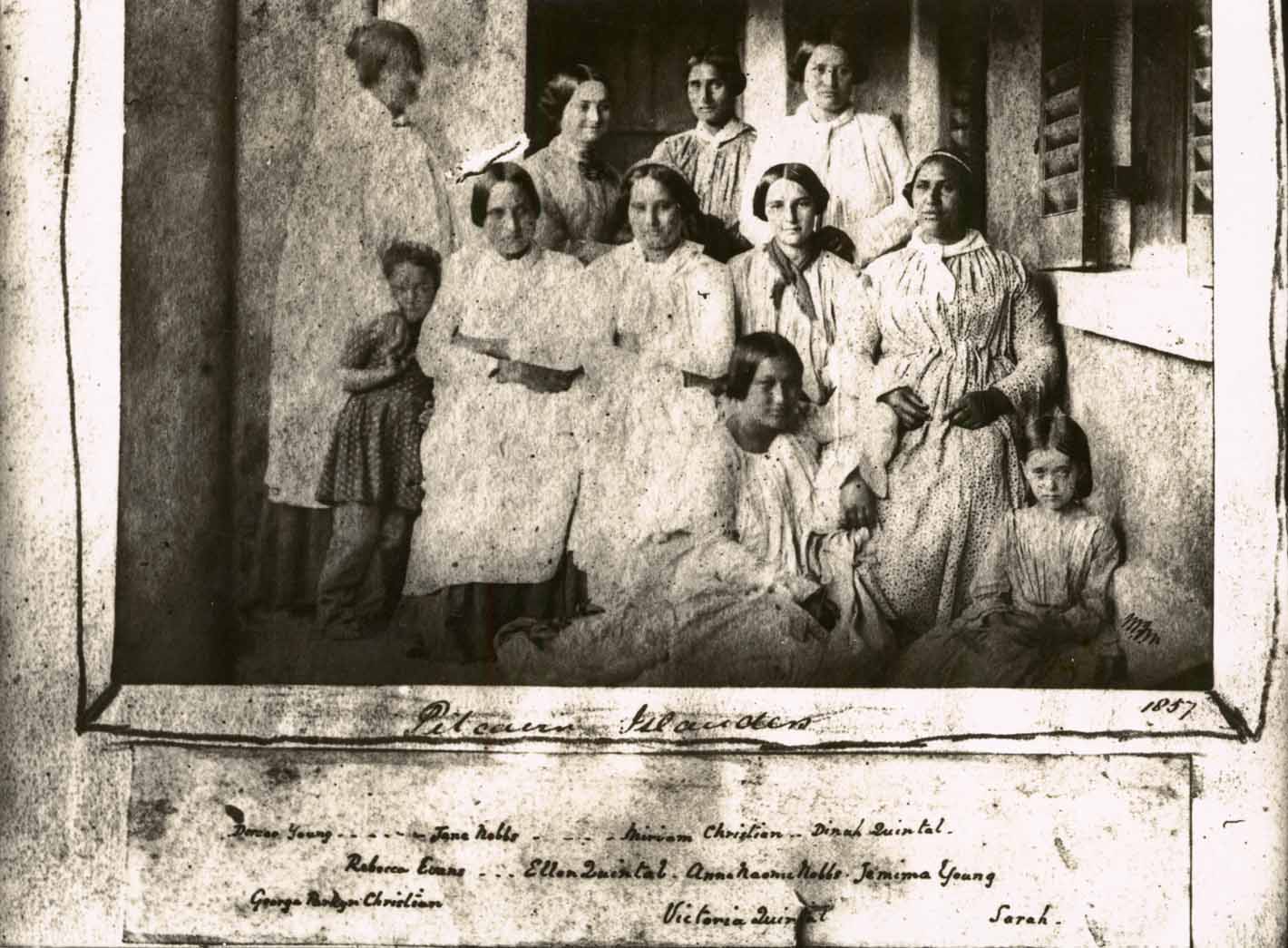
An 1857 photograph of "Pitcairn Islanders." |
Oct. 14, 1857: During a visit to the island, Governor Sir William Thomas Denison frames a constitution called "Laws and Regulations for Norfolk Island." It places the island during the absence of the governor in charge of a government consisting of a chief magistrate and two assistants or councillors, to be elected annually. The chief magistrate must reside on the island, be possessed of a landed estate therein, and be at least 28 years of age. Six months' residence, being 20 years of age, and ability to read and write are the electoral qualifications. The chaplain is to preside at elections and has a casting vote. Education is compulsory; an educational poll-tax of 10s. per year and child is to be paid to the schoolmaster, who is subservient to the chaplain.
August 1858: Two further laws are requested by the islanders and approved by the governor: (1) All persons accused of fornication will, upon conviction thereof, be sentenced to pay a fine of £10. (2) All persons convicted of racing or furious driving through the streets or upon any of the public roads of the settlement will be fined £1.
Dec. 2, 1858: Moses and Mayhew Young, with their wives and twelve children, leave Norfolk Island on the schooner Mary Ann to return to Pitcairn Island. They arrive on Jan. 17, 1859.
1859: A whaling industry is established.
1859: Population: 221.
Sept. 14, 1859: Governor Denison having previously expressed that "my principal object is to get rid of that species of community of property which now exists," the first allocations of individual land ownership are made. A grant of 20 ha is made to the head of each family on Norfolk Island. The grantee is not allowed to sell to persons unconnected with the island. If he wishes to leave the island he can sell to one of the inhabitants; failing that, the community can purchase it at valuation. Thus "strangers" are barred.
Dec. 18, 1863: 27 more Pitcairners leave Norfolk in the schooner St. Kilda to return to Pitcairn. They include Thursday October Christian, Robert Buffett, Samuel Warren (a "mainlander" married to T.O. Christian's daughter), and Simon Young, together with family members. They arrive in early February 1864.
August 1866: The Melanesian Mission is established on Norfolk Island by the bishop of the New Zealand Anglican Church. The Melanesian group is a more or less self-contained community which seems to have little contact with the Pitcairners, who prefer to rely on their own chaplain in religious matters. The mission builds a church, St. Barnabas Chapel, consecrated in 1880.
February 1868: Typhoid fever breaks out amongst the Pitcairners.
July 1869: Rev. George Hunn Nobbs, pastor and physician, supplies the following statistics: births since the exodus from Pitcairn in 1856, 204; deaths, 72, of which 30 took place in 1868; number of inhabitants, January 1868, 300.
February 1874: The church in Kingston is razed by a hurricane. The former commissariat store then becomes a place of worship.
1878: The first government medical officer, Dr. Peter Herbert Metcalfe, arrives from England. Highly esteemed by the population, he also becomes deputy chief magistrate in 1898. He stays on the island until 1912 and dies on April 19, 1913, while relieving for a fellow doctor on Fanning Island (in modern Kiribati), and is then buried on Norfolk on July 21.
Nov. 5, 1884: Nobbs, spiritual leader of the community for 50 years, dies. His funeral is attended by nearly everybody.
1885: Population: 662 (481 islanders, 181 with Melanesian Mission).
1894: The British government appoints commissioners to inquire into matters connected with the administration of justice on Norfolk Island.
Aug. 21, 1895: Henry Robert Brand, Viscount Hampden, the governor-designate of New South Wales, writes to the Colonial Office before leaving for Australia to obtain its "views respecting the affairs of Norfolk Island." He writes that the governors "appear to have preserved as far as possible the laws and usages by which the inhabitants of Norfolk Island had been accustomed to govern themselves when they inhabited Pitcairn Island," but that these, "which for many years were sufficient for the wants of the small community existing on the Island, have been found of recent years to be quite inapplicable to the times and to the condition of the existing population of some 900 persons." He argues "the desirability of persuading the government of New South Wales to assume the charge of Norfolk Island." The Colonial Office responds approvingly on September 18 and the premier of New South Wales, George Reid, in a letter of December 31, says: "If Her Majesty's government is of opinion that Norfolk Island should be attached to this colony, we are quite prepared to administer its affairs." These developments come to the attention of the government of New Zealand, which claims that, as a matter of courtesy, it should have been consulted because Norfolk Island is geographically closer to New Zealand and because the island is an ecclesiastical province of New Zealand. The Colonial Office responds that it was unaware that New Zealand had any desire to make any claim in this matter.
Nov. 14, 1896: The chief magistrate becomes a government rather than islander appointment. Col. Warner Wright Spalding is sworn in to the position during a visit by Governor Lord Hampden. An elective 12-member Council of Elders is instituted, which "will have the care of the roads, commons, and public reserves, and, subject to the approval of the chief magistrate, may make by-laws for the above purpose. They may also suggest alterations in the laws and regulations which they think desirable."
March 19, 1897: A British order-in-council dated January 15 is published, by which Norfolk Island becomes a dependency of (but not annexed to) New South Wales. Little changes in practice, the affairs of the island still being vested in the governor of New South Wales, only directly so instead of as a separate office. The preamble to the order-in-council, however, mentions the prospect of future annexation to New South Wales "or to any federal body of which that colony may hereafter form part."
Dec. 31, 1898: Population: 846.
1902: A Pacific Overseas Cable Station is established at Anson Bay.
1903: A dispute begins in relation to the buildings in the Kingston area which had remained government property and had been occupied by the Pitcairners who allowed them to fall into a state of disrepair. Some of the Pitcairners refuse to accept occupation licenses which would require them to repair and maintain their rent-free buildings and they are evicted by military personnel in 1908.
July 1903: An Executive Council is set up, replacing the Council of Elders. It consists of two elected members and four appointed by the governor, who also appoints the president.
April 1906: It is reported that a state premiers' conference has agreed that the commonwealth government should take over the administration of Norfolk Island. This matter had been under discussion since 1902, following the formation of the Commonwealth of Australia in 1901. On July 14, Norfolk Islanders petition the king to prevent the island being annexed to the commonwealth. (The petitioners are later informed that the petition has been laid before the king, but he has not given any directions on it.)
April 1, 1908: Australian prime minister Alfred Deakin advises parliament that a bill for Norfolk Island control is almost completed and that it is proposed to make the island a territory of the commonwealth. The bill lapses, however, when parliament is prorogued later this year and (after being re-presented) again in 1910. Meanwhile, in 1909, the premier of New South Wales puts forward the proposition that the island should remain under the administration of the governor of the state after all, arguing that the system is now working smoothly and that islanders are unhappy at the prospect of commonwealth control.
1911: Population: 985.
Sept. 9, 1913: Michael Vincent Murphy is installed as administrator. Appointed by the New South Wales governor and an officer of that state's Lands Department, he replaces the chief magistrate.
Sept. 11, 1913: A Norfolk Island Bill is presented again. It passes and is assented to on December 19.
July 1, 1914: By British order-in-council of March 30 and Australian governor-general's proclamation of June 17 (and another petition by Norfolk Islanders in April having no effect), Norfolk Island becomes an Australian territory. It is governed by an appointed administrator (Murphy being reappointed under the commonwealth's administration and continuing in the post until 1920) and an Executive Council enlarged to 12 members, 6 being elected annually and 6 nominated by the administrator.
1914-18: 78 Norfolk citizens (from a community numbering about 800) serve in the Australian and New Zealand forces in World War I.
1920: The Melanesian Mission closes down.
1926: Administrator Edwin Thomas Leane is recalled and a royal commission into Norfolk affairs appointed.
1930: There is a banana boom, with a record 339 ha under cultivation.
March 28, 1931: The first aircraft to Norfolk Island arrives: Francis Chichester in Gipsy Moth-type seaplane Madame Elijah lands at Cascade Bay en route from New Zealand to Australia.
1933: Population: 1,231.
1935: The Executive Council is replaced by an all-elected, 8-member Advisory Council, and a separate office of chief magistrate is constituted. Gradually, the Advisory Council is offered limited local executive authority, but because the administrator has powers of veto that arrangement is not considered satisfactory by the islanders.
1940s: A whaling station is built at Ball Bay. Accidents and fires lead to its closing down in 1950, but in 1956 a new station goes into operation at Cascade. Whaling is a fairly large source of revenue for Norfolk until a shortage of whales brings it to an end in 1962.
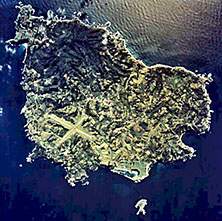
Norfolk Island from the air, with Nepean Island at the bottom. The "X" in the landscape is the airstrip built in 1942. |
December 1942: An airport is completed and first used - constructed for transmitting wartime aircraft. An "N Force" of up to 1,488 personnel from New Zealand's 36th Battalion is garrisoned on Norfolk for the duration of World War II.
March 1, 1943: Mrs. Marianne Selina Buffett, the last of the original Pitcairners who came to Norfolk, dies aged 87.
June 10, 1947: The first Norfolk Island postage stamps are issued.
October-November 1947: Qantas and New Zealand National Airways begin to operate regular flights to Norfolk from Sydney and Auckland, respectively.
1950s: Norfolk has developed into a conservative kind of society, in many ways typical of small-town Australia of the same era or a little earlier.
1953: A memorial is erected at Duncombe Bay, where Captain Cook is believed to have landed.
1956: The centenary of the landing of the Pitcairn Islanders is marked by a week's celebrations, including a reenactment of the original landing.
Dec. 16, 1956: The Duke of Edinburgh visits Norfolk Island.
May 21, 1957: Legislation giving a degree of autonomy to Norfolk Island is introduced in the Australian House of Representatives by the minister for territories, Paul Hasluck, and adopted on the same day. The measure (the Norfolk Island Bill) provides for the setting-up of a council which will have powers to make by-laws, levy rates, and control expenditure, and which will replace the Advisory Council of the island's administrator.
1960s-70s: A certain class of Australian "businessmen" begin registering companies on Norfolk for the purpose of tax evasion.
Early 1960s: A new phase of immigration begins which diminishes the proportion of Pitcairners who hitherto still predominated despite previous dilutions.
April 7, 1960: The Norfolk Island Council Ordinance 1960, bringing into operation the Norfolk Island Act 1957, creates a Norfolk Island Council with a wide range of local government powers. Elected to the first council are: Walter Noel Selby Newbald, Frederick James Needham, Thomas Bray Bailey, Stephen Enoch Nobbs, Gregory Gilbert Francis Quintal, Lavinia Christine Donkin, Leo Vincent Nola, and Franklyn Consett Christian, the first four to hold office for two years and the remainder until July 5, 1961. Donkin is the first woman elected to a public office in Norfolk Island. The council first meets on June 22, Needham being elected president. It immediately resolves that it cannot accept the proposed powers because, first, the administrator is given a power to veto by-laws passed by the council and, second, the council would have to raise its own revenue, the administrator having stated that the traditional sources of revenue would be denied it.
June 30, 1960: Population: 1,035.
1962: Elections substantially reduce the number of councillors generally belonging to "the bloc" who favour taking over executive functions and nothing more is done in the matter.
October 1963: Another Norfolk Island Act is passed, coming into effect on April 27, 1964. It amends earlier acts to provide for the wish of the island people not to participate in executive government of the island and for the 1960 ordinance to be repealed. It also provides for a large measure of consultancy between the council and the administrator. The principal provisions of the Norfolk Island Council Ordinance 1964 are: (1) The administrator is to be ex officio chairman of the council. (2) The council is to have 8 elected members with an elected president of committees. (3) The administrator is to be responsible for maintaining the electoral roll.
June 18, 1964: The Referendum Act 1964 comes into effect, establishing procedures and regulations for popular referendums in Norfolk Island.
1965: In the case of Newbery v. The Queen 7 F.L.R. 34 it is held that the commonwealth parliament has power to make laws for the government of Norfolk Island.
Aug. 6, 1965: The Norfolk Islander appears, the first legal newspaper since a 1935 ordinance (repealed in 1964) banning newspaper publication without the express permission of the administrator. It is edited by Tom Lloyd until 2017.
1970: Population: 1,240.
July 1970: A proposal that the chairman of the council should be elected and the council should exercise some executive powers receives little support at council elections.
Feb. 11, 1974: Queen Elizabeth II visits Norfolk (the first monarch to do so) in the bicentenary year of its discovery.
Oct. 11-13, 1974: Gough Whitlam is the first Australian prime minister to visit Norfolk.
May 15, 1975: A royal commission (with Sir John Nimmo as commissioner) is appointed to report, among other things, on the future status of Norfolk Island and its constitutional relationship to Australia.
March 30, 1976: The High Court of Australia (in the case of Berwick Limited v. R.R. Gray, deputy commissioner for taxation) confirms that Norfolk Island is part of the Commonwealth of Australia and that the lawmaking power conferred upon the federal parliament in respect of Norfolk Island by section 122 of the constitution is plenary, i.e., unrestricted in any sense.
June 30, 1976: Of a total of 859 persons on the electoral roll, Pitcairn descendants number only 323 (37.6%). Non-Pitcairner spouses of Pitcairners number 130, while 406 are not related to Pitcairners at all.
1977: Norfolk Island protests the findings of the Nimmo report tabled in November 1976, which recommended increased integration of the island into the Australian Capital Territory. The islanders demand a referendum on the plan, objecting that it would ruin their way of life and increase taxation. The Norfolk Island Council appeals to the United Nations Committee of 24 (decolonization committee) against the recommendations, claiming separate constitutional, ethnic, and cultural identity. The UN committee declines to consider the submission.
Feb. 27, 1977: Qantas ceases operating the Sydney-Norfolk route.
Early 1978: The Norfolk Island Council unilaterally issues a draft constitution for self-government in free association with Australia. In May Australia announces that it will not assume direct control over the island. After integrationist candidates are defeated in council elections, negotiations begin with a view to handing budgetary control to a legislative assembly in July 1979.
1979: Australia passes the Norfolk Island Act (coming into force when it receives the royal assent on May 30), providing for the establishment of a 9-member Norfolk Island Legislative Assembly (to be elected at least every three years) to assume responsibility for a wide range of functions which were previously handled by the administrator with assistance from the Advisory Council. The Australian government grant is ended, but the island government is given the power to raise and allocate revenue. The first Assembly is elected on August 1 and holds its inaugural meeting on August 10. Its members are:
- William Arthur Blucher (deputy president; deputy chief minister)
- David Ernest Buffett (president; chief minister)
- Edward Davenport Howard
- Gilbert Wallace Jackson
- Bruce Colin Mackenzie
- James Duncan McIntyre
- Bryan Kingsley Nunn
- John Healey Ryves
- Kevin John Williams
July 6, 1979: Peter Coleman is appointed administrator, with effect from September 5.
December 1979: A referendum on the voting system favours a return to first-past-the-post by 463 votes to 339, thus rejecting the Australian-imposed quota-preferential system which was claimed to ensure better representation for the various groups on the island.
1980: Australian plans to upgrade the airfield to allow an increase in tourism are opposed by many islanders (especially the descendants of Pitcairners) on environmental, health, and other grounds.
Jan. 11, 1980: The Norfolk Island flag is proclaimed. A green Norfolk Island pine (Araucaria heterophylla) stands between 2 vertical green bands. The white background on which the pine appears symbolizes peace and harmony between people and the natural world.
Oct. 20, 1980: Queen Elizabeth II grants a coat of arms to Norfolk Island, featuring a lion and kangaroo holding a shield (with a Norfolk Island pine on a rocky mount and two stars, referring to those in the crest of Australia) and the motto "INASMUCH," referring to Matthew 25:40, "Inasmuch as ye have done it unto one of the least of these my brethren, ye have done it unto me."
Nov. 5, 1980: The Legislative Assembly creates an additional executive office of minister for resources and planning. On November 6 James Duncan McIntyre is appointed to the post.
Feb. 19, 1981: The deputy administrator, Ian Hutchison, exercises the functions of the administrator following the departure of Peter Coleman, until the arrival of Acting Administrator Thomas Ferguson Paterson, who takes over May 11.
April 4, 1981: Nunn and Ryves resign.
June 30, 1981: Census population: 2,175 (males 1,067; females 1,108).
July 1, 1981: Alice Inez Buffett and Lisle Denis Snell are sworn in as a result of a by-election on June 24 to fill the two vacancies.
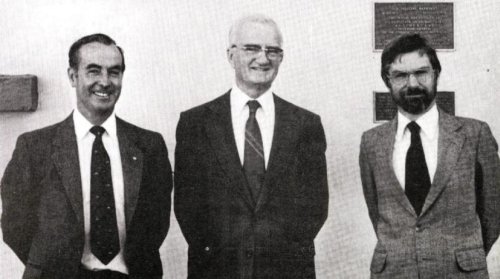
Administrator Raymond Edward Trebilco, Mr. Justice Russell Fox (chief judge of the Supreme Court of Norfolk Island), and President of the Legislative Assembly David Ernest Buffett, 1982. |
Jan. 27, 1982: Elections are held to the Second Legislative Assembly. The membership, with executive posts as appointed on February 11, is as follows:
- John Terence Brown (executive member for planning, tourism, and commerce)
- Alice Inez Buffett
- Bernard Edwin Christian-Bailey
- David Ernest Buffett (president; executive member for administration, education, and health)
- Chloe Barbara Gray
- Edward Davenport Howard (executive member for finance)
- Gilbert Wallace Jackson
- Gregory Francis Quintal
- William Winton Sanders (deputy president)
The previous arrangement of chief minister, deputy chief minister, and executive member for resources and planning has been rejected in favour of three executive members with equal status and operating as a committee under a rotating chairmanship.
Jan. 28, 1982: Air Vice-Marshal Raymond Edward Trebilco is appointed administrator. He arrives on the island on February 8.
Dec. 1, 1982: In a referendum, the question is put: "Are you in favour of a change from the proportional representation type of system of voting to a new cumulative system of voting?" The results are 535 in favour, 302 against, informal votes 6.
Feb. 16, 1983: Another referendum is conducted asking whether a general election should be called immediately under the new cumulative system of voting. 562 are in favour, 306 against, informal 3. Under the so-called Illinois cumulative system, each elector has nine votes to divide and allocate in any combination that does not give one candidate more than four; i.e. giving some support to a minimum of three candidates, for example in a 4-3-2 combination, or 3-3-3, or 4-2-2-1, or 2-2-1-1-1-1-1.
March 1983: Following the Australian federal election, responsibility for Norfolk Island is transferred from the minister for home affairs and environment to the minister for territories and local government (Tom Uren).
May 18, 1983: Elections are held to the Third Legislative Assembly, which is sworn in on May 25, with the administrator appointing members to executive offices on May 26 (again with a chief minister), as follows:
- Brian George Bates (minister for finance)
- John Terence Brown
- Albert Fletcher Buffett
- Alice Inez Buffett (minister for social services and primary industry)
- David Ernest Buffett (president; chief minister)
- Gilbert Wallace Jackson (minister for immigration and lands)
- Phillip Arthur Page (minister for tourism and communications)
- Eleanor Brenda Reed (deputy president; minister for community services)
- William Winton Sanders
July 14, 1983: David Huw Lewis, 38, attempts to seize power at Norfolk Island, leaving a message at the radio station ordering the administrator and his wife to leave the island, claiming that explosive devices have been placed at public buildings, and threatening to release rabbits (a serious pest). He is arrested and deported.
June 5, 1984: Jackson resigns from the Assembly, which then resolves to reduce the ministry to five by abolishing the minister for immigration and lands and changing the designation of the minister for tourism and communications to minister for tourism and lands. Following a by-election on July 24, Edward Davenport Howard is sworn in on July 25 to fill the vacancy.
1985: Legislative and executive responsibility is assumed by the Norfolk Island government for public works and services, civil defense, betting and gaming, territorial archives, and matters relating to the exercise of executive authority.
March 13, 1985: Commodore John Alexander Matthew is appointed administrator, effective April 29.
1985-86: The governments of Australia and Norfolk Island jointly establish the 465-ha Norfolk Island National Park. This is to protect the remaining native forest, which is the habitat of several unique species of flora (including the largest fern in the world) and fauna (such as the Norfolk Island green parrot, the boobook owl, and the already possibly extinct guavabird, or grey-headed blackbird, last seen in 1975).
1986: The Advisory Committee to the Constitutional Commission holds public hearings on Norfolk Island. The commission is an independent body established to examine and review the need to revise the Australian constitution. A submission made on behalf of the Norfolk Island Assembly, while acknowledging "the close and friendly relations between Norfolk and Australia," argues that the federal constitution should be amended to remove doubts as to whether Norfolk Island can be regarded as a dependency of the commonwealth.
May 21, 1986: Elections are held to the Fourth Legislative Assembly. The elected members are (with executive offices, the president of the Assembly now functioning as head of government):
- Gerardus Hendrikus Aafjes (deputy president)
- Geoffrey James Bennett (minister for commerce and health)
- John Terence Brown (president)
- David Ernest Buffett
- Rosemary Gaye Evans
- Edward Davenport Howard (minister for finance)
- David John Rodgers
- Helen Victoria Sampson
- William Winton Sanders (minister for planning)
At the same time the question of introducing television is put to the community: "Would television as proposed by the Norfolk Island government be good for Norfolk Island?" The result is yes 489, no 476, informal 8. As the number of votes in favour does not exceed the number of votes cast against by 10% or more of the total, the electors are deemed not to have expressed their opinion.
June 30, 1986: Census population: 2,367 (males 1,170; females 1,197), including 390 visitors.
1987: The Advisory Committee's report rejects the proposal that the island be given a new status. It also notes that no problems have been identified which result from Norfolk Island's status as part of the Australian Commonwealth. It also comments that submissions received from the island reflect considerable differences of opinion within the Norfolk community about the island's relationship with the rest of Australia.
August 1987: A television service is established, with programmes relayed via satellite from the Australian Broadcasting Corporation in Sydney.
1988: The Legislative Assembly is empowered to select a Norfolk Island government auditor (territorial accounts having previously been audited by the commonwealth auditor-general).
1988: By this time the rabbits on Phillip Island are exterminated. Together with pigs and goats, which were removed by the early 20th century, they devastated the vegetation, giving the island a reddish-brown colour. In the following years the island regenerates.
May 10, 1989: The 9 seats in the legislature are contested by 16 candidates. The Fifth Legislative Assembly is sworn in on May 17:
- William Arthur Blucher (minister for immigration and commerce)
- John Terence Brown (deputy president)
- Alice Inez Buffett
- David Ernest Buffett (president)
- Ernest Christian
- Neville Charles Christian (minister for finance)
- Rosemary Gaye Evans (minister for community services)
- Cedric Ion-Robinson
- George Charles Smith (minister for tourism)
July 17, 1990: Evans resigns as minister for community services. On July 18 she is elected deputy president following the resignation of Brown from the position. On August 15 Ernest Christian is elected minister for community services.
April 17, 1991: Blucher resigns as minister for immigration and commerce. His responsibilities are shared between existing executive members.
July 12, 1991: Evans resigns from the Assembly. On July 17 Blucher is appointed deputy president.
Aug. 6, 1991: Census population: 2,285 (males 1,111; females 1,174), including 373 visitors.
Sept. 20, 1991: William Winton Sanders is sworn in as a result of a by-election to fill the vacancy.
Dec. 4, 1991: The population of Norfolk Island overwhelmingly (by 81.2%) rejects a proposal, made by the Australian government, to include the island in the Australian federal electorate.
April 13, 1992: Alan Gardner Kerr takes office as administrator.
May 13, 1992: The Sixth Legislative Assembly is elected (contested by 20 candidates), and sworn in on May 20:
- Brian George Bates
- Geoffrey James Bennett (minister for finance)
- John Terence Brown (president; minister for health and education)
- David Ernest Buffett (deputy president)
- Ernest Christian
- Michael William King (minister for community services)
- Cedric Ion-Robinson
- William Winton Sanders (minister for immigration and tourism)
- Lester Reid Semple
June 1992: The Australian government announces that it has abandoned the plan to include the island in the federal electorate.
April 27, 1994: Early elections to the 9 seats in the legislature are held due to a lack of consensus among members of the Executive Council on several major issues. The Seventh Legislative Assembly, notable for including three female members, is sworn in on May 4:
- Robert Eric Adams
- Monica Jean Anderson (deputy president)
- Brian George Bates
- Geoffrey James Bennett (minister for finance)
- David Ernest Buffett (president)
- Neville Charles Christian (minister for the environment)
- Nadia Lozzi Cuthbertson (minister for health and education)
- Michael William King (head of government, minister for tourism and works)
- Helen Victoria Sampson
1995: Sections 41 and 42 of the Norfolk Island Act 1979 are amended to replace the terms "President" and "Deputy President" (of the Legislative Assembly) with "Speaker" and "Deputy Speaker," so as to remove doubt about the proper role of the speaker, who had previously been regarded as the head of government.
July 4, 1995: Bennett resigns as member of the Assembly.
July 10, 1995: Robert Eric Adams becomes minister for industry and forests and Michael William King minister for tourism and finance.
Aug. 23, 1995: George Charles Smith is sworn in as a result of a by-election to fill the vacancy created by Bennett's resignation.
April 2, 1996: Former administrator (1976-79) Desmond Vincent O'Leary dies.
July 24, 1996: David Robert Gerard Evans is sworn in as a result of a by-election to fill a vacancy created by the resignation of Helen Sampson.
Aug. 6, 1996: Census population: 2,181 (males 1,039; females 1,142), including 409 visitors. The census identifies 80.8% of the permanent population as Australian citizens (up from 77% in 1991) and 16% as New Zealand citizens (down from 18.5%); U.K. citizens account for 1.7%, and the remaining 1.5% hold other citizenship.
Late 1996: A proposal by the Australian government to combine Norfolk Island's population with that of the federal capital of Canberra for record-keeping purposes is strongly opposed by the islanders.
1997: The cessation of scheduled services from Australia by Ansett Australia has an adverse effect on the island's important tourist industry. As a consequence, Norfolk Jet Express is established to provide a weekly service to Australia.
April 30, 1997: In elections to the 9-member Assembly (contested by 22 candidates), only nonpartisans (including three new members) are elected. The Eighth Legislative Assembly is sworn in on May 5:
- Robert Eric Adams
- Brian George Bates
- John Terence Brown (minister for health and immigration)
- David Ernest Buffett (deputy speaker)
- Geoffrey Robert Gardner
- Ronald Coane Nobbs
- James Gary Robertson (minister for tourism and commerce)
- Cedric Ion-Robinson
- George Charles Smith (speaker, chief minister, and minister for finance and strategic planning)
Aug. 4, 1997: Tony Messner becomes administrator.
Late 1997: The Assembly debates the issue of increased self-determination for the island. Pro-independence supporters argue that the territory could generate sufficient income by exploiting gas and oil fields in the island's exclusive economic zone.
Nov. 20, 1998: Geoffrey Robert Gardner becomes minister for health and Cedric Ion-Robinson minister for immigration and resource management. They succeed John Terence Brown, who was minister for health and immigration until November 19.
1998-99: The Norfolk Island government, being opposed to Australian plans to bring Norfolk's electoral system into line with those in all other Australian parliaments, initiates two referenda on the issue. The first referendum, in August 1998, asks those on the current electoral roll whether Norfolk Islanders feel it appropriate that "the Australian government in Canberra dictates the electoral process on Norfolk Island." Of 1,114 enrolled, 917 vote, with 78.4% voting "no" and 20.1% "yes." The second referendum, in May 1999, asks whether Norfolk Islanders agree with the federal government's proposal to alter the Norfolk Island Act so that in future people who have been ordinarily resident on the island for six months would be entitled to enrol on the electoral roll for Legislative Assembly elections; and Australian citizenship be a requirement for election to the Assembly and for enrolment on the electoral roll for Assembly elections. Of the 1,110 enrolled, 964 vote, with 71.7% voting "no" and 25.6% "yes." Norfolk's current electoral laws require an aggregate physical presence on the island of 900 days in the previous four years.
Early 1999: The Legislative Assembly announces plans to seek assistance from the Australian government to establish an offshore financial centre on the island.
February 1999: Air Nauru begins to operate a weekly charter flight service to Norfolk Island from Sydney, under contract with Norfolk Jet Express.
April 16, 1999: Allan John McCoy is sworn in as a result of a by-election to fill the vacancy created by the resignation (February 25) of Robert Adams.
Mid-1999: Frustration with the Australian government's perceived reluctance to facilitate the transfer of greater powers to the territory (as outlined in the 1979 Norfolk Island Act) leads the Legislative Assembly to vote (7-1) in favour of full internal self-government.
Sept. 9, 1999: The Supreme Court declares Nobbs not duly elected as a member.
Oct. 14, 1999: Nobbs is reelected and sworn in as a result of a by-election caused by the Supreme Court ruling.
2000: Negotiations regarding the administration of crown land on the island continue and are seen as indicative of the islanders' determination to pursue greater independence from Australia.
Feb. 23, 2000: Results of the Legislative Assembly election:
| Candidate | Votes | % |
| Ronald Coane Nobbs | 1,347 | 15.0 |
| Geoffrey Robert Gardner | 1,262 | 14.1 |
| Adrian George Hingston Cook | 1,104 | 12.3 |
| George Charles Smith | 801 | 8.9 |
| David Ernest Buffett | 787 | 8.8 |
| Allan John McCoy | 741 | 8.3 |
| Bruce Stanley Walker | 618 | 6.9 |
| Brian George Bates | 410 | 4.6 |
| John Terence Brown | 375 | 4.2 |
| Cedric Newton Ion-Robinson | 341 | 3.8 |
| James Gary Robertson | 339 | 3.8 |
| Graeme Rex Woolley | 331 | 3.7 |
| Neville Charles Christian | 256 | 2.9 |
| David Robert Gerard Evans | 234 | 2.6 |
| Total | 8,946 |
The Ninth Legislative Assembly (including three new members) is sworn in on February 28:
- Brian George Bates
- John Terence Brown
- David Ernest Buffett (speaker)
- Adrian George Hingston Cook (minister for immigration and community services)
- Geoffrey Robert Gardner (minister for health and environment)
- Allan John McCoy (deputy speaker)
- Ronald Coane Nobbs (chief minister and minister for finance and government services)
- George Charles Smith (minister for tourism and commerce)
- Bruce Stanley Walker
Jan. 5, 2001: Adrian Cook resigns as minister for immigration and community services. David Ernest Buffett succeeds him on January 25.
March 9, 2001: Geoffrey Robert Gardner resigns as minister for health and environment. Allan John McCoy succeeds him on April 21.
Aug. 7, 2001: Census population: 2,601 (males 1,257; females 1,344), including 564 visitors. 82.5% of the permanent population holds Australian citizenship, 14.1% New Zealand citizenship, 1.4% U.K. citizenship, other countries 1.7%, not stated 0.3%.
Sept. 13, 2001: Robert Eric Adams is sworn in as a result of a by-election to fill the vacancy created by the resignation of Adrian Cook on July 25.
Oct. 24, 2001: Following a public petition, a referendum is held against continuing the current legislature. To the question "Should a new election be held for the full membership of the Legislative Assembly at the earliest convenient date?," 555 vote yes, 379 no, 11 informal (total 945).
Nov. 29, 2001: Results of the Legislative Assembly election, in which 19 candidates stand, including all but one of the existing members:
| Candidate | Votes | % |
| Geoffrey Robert Gardner | 930 | 10.1 |
| David Ernest Buffett | 859 | 9.3 |
| Ivens François Buffett | 712 | 7.7 |
| George Charles Smith | 656 | 7.1 |
| Graeme Donaldson | 646 | 7.0 |
| Stephanie Victoria Anne Jack | 546 | 5.9 |
| Chloe Barbara Nicholas | 519 | 5.6 |
| John Terence Brown | 504 | 5.5 |
| Ronald Coane Nobbs | 491 | 5.3 |
| Neville Charles Christian | 488 | 5.3 |
| Adrian George Hingston Cook | 480 | 5.2 |
| Colleen V. Evans | 435 | 4.7 |
| Bruce Stanley Walker | 351 | 3.8 |
| Allan John McCoy | 311 | 3.4 |
| Brian George Bates | 309 | 3.3 |
| William Winton Sanders | 305 | 3.3 |
| Nadia Lozzi Cuthbertson | 261 | 2.8 |
| Michael Perkins | 261 | 2.8 |
| Graeme Rex Woolley | 179 | 1.9 |
| Total | 9,243 |
Turnout is 88.4%. The Tenth Legislative Assembly (including four new members) is sworn in on December 5:
- John Terence Brown
- David Ernest Buffett (speaker and minister for community services and tourism)
- Ivens François Buffett (minister for land and the environment)
- Graeme Donaldson (minister for finance)
- Geoffrey Robert Gardner (chief minister and minister for intergovernmental relations)
- Stephanie Victoria Anne Jack
- Chloe Barbara Nicholas (deputy speaker)
- Ronald Coane Nobbs
- George Charles Smith

Murder victim Janelle Patton. |
March 31, 2002: The stabbing murder of Janelle Patton, 29, an Australian woman who had been working on Norfolk, shatters the peace of the tranquil island community. It is the first recorded homicide in 150 years in this crime-free haven whose residents have never bothered to lock their doors. Now, however, people buy locks for their houses, the rumour mill goes off, and many of the permanent residents find it hard to accept the fact that the killer might be a local, hoping instead that it was one of the 400 or so TEPs (pronounced "tee-pees"), the mainly young people on three-year temporary entry permits who come to earn tax-free dollars as waiters and shop assistants. A downpour having washed away crucial evidence before police could be flown from the mainland, the mass fingerprinting of 1,000 Norfolk residents begins on August 12; the exercise is to be extended to 680 Australians and New Zealanders holidaying on the island at the time of the murder. When in March 2003 the Australian police is no closer to finding the killer, Norfolk Island posts a A$50,000 reward in a bid to solve the crime.
June 18, 2002: Cedric Newton Ion-Robinson (b. Sept. 18, 1950, Apia, Western Samoa) changes his name to Ric Newton Ion Robinson.
August 2002: In a referendum, almost two-thirds of those who participate vote not to allow the operation of mobile telephones on the island (yes 356, no 607).
March 24, 2003: It is reported that the Legislative Assembly has voted overwhelmingly to approve amendments to 1979 legislation governing electoral qualifications for Norfolk Island. The bill adds Australian, New Zealand, or U.K. citizenship as a condition for enrolment and reduces the residency requirement from 900 days to 12 months. Chief Minister Geoff Gardner introduced the bill as a compromise with the Australian government, which in February had announced that it intended to reduce the residency qualification for Australian citizens to six months. The amendments, which follow a series of occasionally acrimonious discussions with the Australian government, provoke concern among islanders who fear that succumbing to Australian pressure to reform the Norfolk Island Act will result in the effective removal of authority over electoral matters from island control.
July 2003: A report by an Australian parliamentary committee is published which is critical of Norfolk Island's government and public services. Many residents believe that the report constitutes a further attempt by Australia to undermine their autonomy. The chief minister rejects the committee's claims. A further report by the Australian government published later in the year alleges that officials on the island use intimidation to achieve political and financial gain and recommends that Norfolk Island's elections, government, and financial matters be overseen by the federal authorities.
Nov. 1, 2003: Grant Tambling takes office as administrator.
Dec. 17, 2003: George Smith resigns from the Assembly.
March 2004: The territory approves legislation to grant a monopoly on satellite Internet connections to the government-owned Norfolk Telecom. The legislation, which is expected to put the territory's private Internet service provider, Norfolk Island Data Services, out of business, is criticized by the Australian government.
March 2004: The reward for information about the Patton murder is tripled. In May a further inquest is launched.
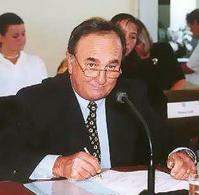
Murder victim Ivens Buffett. |
July 19, 2004: Ivens "Toon" Buffett, 60, the deputy chief minister and land and environment minister, is shot dead in his office with his own Lee-Enfield .303 rifle, allegedly by his son, Leith Maclean Buffett, 25, who is arrested and charged on the same day - the first murder charge to be laid on the island for 150 years. Because of Norfolk Island's lack of suitable facilities to hold him, he is transferred on October 16 to New South Wales authorities, to undergo a mental health assessment at the Long Bay prison hospital in the Sydney suburb of Malabar. He is found to be incompetent to stand trial owing to severe mental illness.
Oct. 20, 2004: In Legislative Assembly elections, two-thirds of the sitting members are seeking reelection. 14 candidates stand altogether, among them Terence Fletcher Jope, one of 16 "persons of interest" to police investigating Janelle Patton's murder, Ric Robinson, whose wife is author Colleen McCullough, and John Walsh of Brannagh, once chancellor of the virtual Greenwich University, shut down by the Australian government in 1999. 1,215 (91.2%) of the island's 1,332 registered voters cast a total of 10,503 votes. Chief Minister Gardner is topping the poll. Two previous Assembly members, Chloe Nicholas and Ric Robinson, are unsuccessful.
| Candidate | Votes | % |
| Geoffrey Robert Gardner | 1,809 | 17.2 |
| Timothy John Sheridan | 1,436 | 13.7 |
| Neville Charles Christian | 949 | 9.0 |
| Lorraine Carol Boudan | 838 | 8.0 |
| Ronald Coane Nobbs | 810 | 7.7 |
| David Ernest Buffett | 755 | 7.2 |
| John Terence Brown | 674 | 6.4 |
| Stephanie Victoria Anne Jack | 652 | 6.2 |
| Timothy John Brown | 628 | 6.0 |
| Chloe Barbara Nicholas | 566 | 5.4 |
| Ric Newton Ion Robinson | 512 | 4.9 |
| John Francis Patrick Cyril Colclough Walsh of Brannagh | 426 | 4.1 |
| Terence Fletcher Jope | 226 | 2.2 |
| Craig Andrew Robinson | 222 | 2.1 |
| Total | 10,503 |
The Eleventh Legislative Assembly (sworn in October 27):
- Lorraine Carol Boudan
- John Terence Brown (minister for community services)
- Timothy John Brown (deputy speaker)
- David Ernest Buffett (speaker)
- Neville Charles Christian
- Geoffrey Robert Gardner (chief minister)
- Stephanie Victoria Anne Jack (minister for the environment)
- Ronald Coane Nobbs (minister for finance)
- Timothy John Sheridan
Dec. 21, 2004: An act to recognize Norf'k (or Norfuk), the local creole, as an official language alongside English is assented to. Norf'k (a hybrid of Tahitian and 18th-century English) is subsequently introduced into the school curriculum on Norfolk Island, its usage having previously been forbidden in schools. The act, however, provides that Norf'k "when used in official communications must always be accompanied by an accurate translation in the English language" and that while it may be used in schools, "no child shall be compelled to learn or be instructed in it."
June 2005: The environmental organization Greenpeace releases photographic evidence of marine destruction caused by bottom trawling in international waters near Norfolk Island. The organization's claims, which were repeatedly refuted by the fishing companies involved, are dramatically substantiated by photographs and film of centuries-old, endangered coral trees being removed from trawler nets and dumped in the sea. The New Zealand government subsequently indicates its support for a UN moratorium on bottom trawler fishing in international waters, including areas such as the West Norfolk Ridge, described as a globally important area of marine biodiversity.
Feb. 1, 2006: Geoffrey Robert Gardner becomes speaker of the Legislative Assembly.
Feb. 1, 2006: Glenn McNeill, 28, is arrested in Nelson, New Zealand, and charged with the 2002 murder of Janelle Patton. On February 7 his extradition to Norfolk Island is approved. McNeill had held a temporary entry permit to work on Norfolk Island and was working there as a chef at the time Patton was killed. During the investigations three-quarters of the population (those between 15 and 70) were fingerprinted.
Feb. 20, 2006: Australian minister of territories Jim Lloyd announces that the government has concluded that the current self-government arrangements under the 1979 Norfolk Island Act will have to be modified, because a 2005 financial study concluded that the island would otherwise become insolvent within two years. The federal government will undertake consultations with the Norfolk Islanders on different options involving greater federal intervention in the administration of the island. A spokesman for the Norfolk Island chief minister expresses surprise at the announcement, saying that hitherto there has been no consultation.
June 2, 2006: David Ernest Buffett is appointed chief minister.
June 8, 2006: On Bounty Day, descendants of the Bounty mutineers mark 150 years of life on the island. Finance Minister Neville Christian reenacts events in period costume. But his news is not good: the territory is going bankrupt and Canberra is pressing it to hand over control of immigration and introduce income tax. Tourism is down from 40,000 to 28,000 a year. Australians need a visa to visit and restrictions are imposed on those who want to settle or buy land.
Aug. 8, 2006: Census population: 2,523 (males 1,218; females 1,305), including 1,863 "ordinarily resident" and 660 visitors.
Aug. 11, 2006: After a five-day hearing, magistrate Ron Cahill orders Glenn McNeill to stand trial for the murder of Patton.
Aug. 21, 2006: It is reported that Australia's territories minister Jim Lloyd has said that Norfolk has accepted a proposal that it move toward a status similar to that of the Northern Territory and the Australian Capital Territory.
Nov. 7, 2006: It is reported that High Court proceedings begin to determine the constitutional status of Norfolk Island. They were started earlier in the year by then chief minister Gardner and an island resident Geoff Bennett in an attempt to resist plans by the Australian federal government to reduce the islanders' level of autonomy. Specifically they challenge new electoral laws requiring voters to be citizens of Australia, claiming that this does not take into consideration the fact that a proportion of Norfolk Island's adult population does not have Australian citizenship.
Dec. 20, 2006: It is reported that the federal Australian government has decided not to go ahead with plans to change the self-governance structure of Norfolk Island. Minister Jim Lloyd says that any change to the system could disrupt Norfolk Island's fragile economy. The island's administration needs some A$38 million in education and infrastructure costs, with a borrowing requirement of more than half of that.
March 9, 2007: McNeill is convicted of killing Patton in the island's first murder trial in over 150 years. McNeill told the police that after accidentally running over Patton with his car he had panicked, and stabbed her to death on discovering that she was still alive, but retracted this confession in court, saying that he had been suffering mental health problems at the time. McNeill's lawyers say that they will appeal against the conviction.
March 19, 2007: Despite the 2002 referendum, mobile phones are introduced. Following a consultation carried out for Norfolk Telecom, the Legislative Assembly ruled it was economically essential to embrace the technology.
March 21, 2007: An election is held for the Legislative Assembly. Of 1,237 voters on the roll, 1,153 (93.2%) vote.
| Candidate | Votes | % |
| Andre Neville Nobbs | 1,261 | 13.0 |
| Christopher Adam Christian Magri | 1,227 | 12.6 |
| Brendon Alec Christian | 1,151 | 11.8 |
| Stephanie Victoria Anne Jack | 807 | 8.3 |
| Neville Charles Christian | 711 | 7.3 |
| Ian Ross Mackenzie Anderson | 662 | 6.8 |
| Lisle Denis Snell | 650 | 6.7 |
| Geoffrey Robert Gardner | 625 | 6.4 |
| Timothy John Sheridan | 617 | 6.3 |
| Ronald Coane Nobbs | 441 | 4.5 |
| David Ernest Buffett | 355 | 3.7 |
| Maureen King | 315 | 3.2 |
| John Terence Brown | 234 | 2.4 |
| Terence Fletcher Jope | 205 | 2.1 |
| Lorraine Carol Boudan | 189 | 1.9 |
| Timothy John Brown | 161 | 1.7 |
| Frederick William Howe | 109 | 1.1 |
| Total | 9,720 |
The Twelfth Legislative Assembly (sworn in March 28):
- Ian Anderson
- Brendon Christian
- Neville Charles Christian (minister for finance)
- Geoffrey Robert Gardner (minister for tourism and health)
- Stephanie Victoria Anne Jack (minister for the environment, education, and social welfare)
- Christopher Magri (minister for commerce and industry)
- Andre Neville Nobbs (chief minister)
- Timothy John Sheridan (deputy speaker)
- Lisle Denis Snell (speaker)
April 27, 2007: The High Court dismisses the challenge to the validity of commonwealth legislation that requires voters and candidates in Norfolk Island elections to be Australian citizens.
July 25, 2007: At a court hearing held in Sydney, Norfolk Island chief justice Mark Weinberg sentences McNeill to 24 years in prison. He will serve his sentence in Australia, as the territory has no jail. Justice Weinberg orders that McNeill will spend at least 18 years in prison for the "callous and senseless" murder.
August 2007: UNESCO places Norf'k on its list of endangered languages.
August 2008: The government of Norfolk Island issues its response to an Australian Senate committee inquiry into the financial management of the island. The local government claims that the existing arrangements remain viable, reiterating its commitment to the continued improvement of the delivery of services on the island. The government expresses particular concern in relation to its repeated obligation to divert the island's scarce human and financial resources to the task of responding to what is perceived to be constant scrutiny by external committees and consultants, often with regard to issues that it believes to have been adequately addressed on previous occasions.
October 2008: Bob Debus, the Australian minister for home affairs (whose remit includes responsibility for Australian territories), warns that Norfolk Island is in danger of becoming a "failed state." The minister subsequently visits the island, where he has discussions with Chief Minister Nobbs. In December the island's government submits its formal response to the concerns raised by Debus, in which it disputes the minister's claims that the current governance arrangements are operating "to the disadvantage of many on Norfolk Island." The local government reiterates the view that, while the island might benefit from minor modifications to the legislation of 1979, the implementation of radical changes is unnecessary. Meanwhile, the government commissioned an independent review of the Norfolk Island Act of 1979, following which detailed proposals for the simplification and modernization of the prevailing legislation are presented to Debus. The retention of the role of administrator is envisaged.
Oct. 2, 2008: Owen Walsh (already acting since August 2007) is sworn in as administrator.
Nov. 13, 2008: The inaugural meeting is held of a new Council of Elders, established by the Legislative Assembly in recognition of the former traditional leadership system brought to Norfolk Island from Pitcairn Island, and charged with the protection, preservation, and promotion of the island's unique traditional knowledge and expressions of culture.
2009: Norfolk Island government officials have discussions about governance reforms with Debus and, following the latter's retirement, with the new minister for home affairs, Brendan O'Connor. By the end of the year no substantive progress has been achieved, although it has been agreed that more regular meetings to discuss self-governing arrangements, particularly financial matters and accountability, will take place.
March 17, 2010: The Territories Law Reform Bill 2010 is introduced into the House of Representatives in Canberra. It is envisaged that the governor-general of Australia and the federal minister responsible for Norfolk Island will play a more active role in the drafting and enactment of legislation. The radical reforms are to include provision for the removal of the chief minister by the administrator in "exceptional circumstances." While the Norfolk Island government acknowledges the need for reform, it regards the draft legislation as inappropriate and raises numerous concerns, particularly in relation to the proposed reduction in local powers. In December 2006 the Australian government led by Prime Minister John Howard backed down from similar proposals for reform.
March 17, 2010: Elections are held to the Legislative Assembly, contested by 28 candidates.
| Candidate | Votes | % |
| Timothy John Sheridan | 934 | 9.7 |
| Craig Maurice Anderson | 813 | 8.4 |
| Andre Neville Nobbs | 717 | 7.4 |
| David Ernest Buffett | 576 | 6.0 |
| Melissa Ward | 554 | 5.8 |
| Michael William King | 545 | 5.7 |
| Lisle Denis Snell | 472 | 4.9 |
| Rhonda Evelyn Griffiths | 459 | 4.8 |
| Robin Eleanor Adams | 452 | 4.7 |
| Neville Charles Christian | 445 | 4.6 |
| Brendon Alec Christian | 385 | 4.0 |
| Allan David Tavener | 358 | 3.7 |
| Robert George Goldsworthy | 313 | 3.3 |
| Ric Newton Ion Robinson | 297 | 3.1 |
| Richard Aaron Kleiner | 269 | 2.8 |
| Wallace James Beadman | 257 | 2.7 |
| Stephanie Victoria Anne Jack | 254 | 2.6 |
| Frederick William Howe | 232 | 2.4 |
| Brendon Scott King | 215 | 2.2 |
| Julieanne Burns | 191 | 2.0 |
| Phillip Darrell Jones | 169 | 1.8 |
| Nadia Cuthbertson | 164 | 1.7 |
| Graeme Rex Woolley | 158 | 1.6 |
| Maureen King | 144 | 1.5 |
| Norris S. Buffett | 109 | 1.1 |
| Terence Fletcher Jope | 88 | 0.9 |
| Douglas Wallace Jackson | 39 | 0.4 |
| Ian Ross Mackenzie Anderson | 21 | 0.2 |
| Total | 9,630 |
A referendum is held at the same time on the question "Do you think that the profitable publicly owned Norfolk Island Liquor Supply Service should be sold to private enterprise - yes or no?" The result is 132 yes, 963 no, and 9 informal votes. The Thirteenth Legislative Assembly (sworn in March 24):
- Robin Eleanor Adams (speaker)
- Craig Maurice Anderson (attorney-general and minister for finance)
- David Ernest Buffett (chief minister)
- Rhonda Evelyn Griffiths
- Michael William King
- Andre Neville Nobbs (minister for tourism, industry, and development)
- Timothy John Sheridan (minister for community services)
- Lisle Denis Snell (deputy speaker)
- Melissa Ward
May 2010: The Australian parliament's Joint Standing Committee on the National Capital and External Territories, which was required to conduct an inquiry, concludes that the proposed reforms would lead to improvements in the accountability and transparency of Norfolk Island's governance, recommending that the changes be adopted.
October 2010: It is reported that, in collaboration with an Australian university, the world's first trial of a personal carbon trading programme is to commence on Norfolk Island in 2011. In addition to reducing greenhouse gas emissions, it is hoped that the three-year trial will reduce obesity and improve the health of islanders. Residents and visitors to the island are to be offered a carbon credit card, to be used initially when purchasing petrol or power. Frugal users will be able to exchange the remaining units of their annual quota for cash. Researchers hope to add foodstuffs to the scheme in 2012, ranking products in terms of health as well as carbon costs.
Nov. 5, 2010: It is reported that the Norfolk Island Assembly has backed in principle the Territories Law Reform Bill, which is passed by the Australian federal legislature on November 29 and assented to on December 10. The new law contains a package of reforms through which Norfolk Island will cede a degree of autonomy by becoming more accountable administratively and financially to the Australian Commonwealth. It is likely that the islanders will begin to pay income tax, but in exchange they will gain access to federal financial support, welfare, and medical benefits. The stringent conditions attached to the Australian government's provision of emergency funding include the introduction of federal law in areas such as privacy and freedom of information. Under an initial funding agreement concluded in December, the federal government is to provide A$3.8 million in emergency financial support for Norfolk Island for the remainder of the 2010/11 financial year.
March 2011: Craig Anderson resigns as attorney-general and minister for finance, although he remains a member of the Legislative Assembly. His ministerial duties are redistributed between the remaining three members of the Executive Council, with Chief Minister Buffett notably assuming responsibility for most financial matters and justice.
March 2, 2011: The federal and local governments agree on a "road map" outlining a five-year plan for wide-ranging reforms in Norfolk Island aimed at improving governance and economic and social conditions, including the introduction of the Australian taxation system and social security arrangements.
April 2011: The provision of a further A$5.6 million for 2010/11 is agreed.
Aug. 9, 2011: Census population: 2,302 (males 1,082; females 1,220), comprising 1,795 "ordinarily resident" and 507 visitors.
September 2011: A funding agreement for 2011/12 is signed: in return for federal funding of up to A$2.9 million, the local government is to implement further reforms, including the gradual removal of immigration restrictions on Australian citizens moving to Norfolk Island and the reduction of barriers to competition for businesses.
Feb. 13, 2012: Neil Pope is appointed administrator, effective April 1.
December 2012: A funding agreement is signed under which the local government will receive A$4.5 million during the remainder of the 2012/13 financial year, in return for a series of conditions being met on reforms involving, inter alia, immigration and taxation arrangements, the licensing of tourist accommodation, health care and other public services, and the liberalization of the telecommunications sector.
March 13, 2013: Elections to the Legislative Assembly are contested by 15 candidates. Turnout is 93.5%.
| Candidate | Votes | % |
| Lisle Denis Snell | 869 | 9.9 |
| Robin Eleanor Adams | 781 | 8.9 |
| Ronald John Ward | 767 | 8.8 |
| Timothy John Sheridan | 744 | 8.5 |
| Melissa Ward | 715 | 8.2 |
| David Ernest Buffett | 709 | 8.1 |
| David Raymond Porter | 704 | 8.0 |
| Ronald Coane Nobbs | 647 | 7.4 |
| Hadyn Paul "Teddy" Evans | 636 | 7.3 |
| John Francis Kelly | 440 | 5.0 |
| Rhonda Evelyn Griffiths | 420 | 4.8 |
| Fred Howe | 420 | 4.8 |
| Neville Charles Christian | 387 | 4.4 |
| Terence Fletcher Jope | 303 | 3.5 |
| Ian Ross Mackenzie Anderson | 206 | 2.4 |
| Total | 8,748 |
All are nonpartisans except Dave Porter and Ian Anderson, fielded by the Norfolk Liberals. The 14th Legislative Assembly:
- Robin Eleanor Adams
- David Ernest Buffett
- Hadyn Paul "Teddy" Evans
- Ronald Coane Nobbs
- David Raymond Porter
- Timothy John Sheridan
- Lisle Denis Snell
- Melissa Ward
- Ronald John Ward
On March 20 David Buffett is elected speaker, Ron Nobbs deputy speaker, and Lisle Snell (in an 8-1 vote) chief minister. Snell subsequently announces the appointment of Robin Adams as minister for cultural heritage and community services, Ron Ward as environment minister, and Tim Sheridan as finance minister.
May 2013: As part of the reform process agreed between the territory and the federal government, Norfolk Island's immigration regulations are amended, permitting Australian and New Zealand citizens to visit without a permit and facilitating procedures for them to become residents of the territory.
June 17, 2014: Gary Hardgrave is appointed as administrator, effective July 1.
October 2014: An updated report on Norfolk Island's prospects - entitled "Same Country: Different World - The Future of Norfolk Island" and compiled by a federal parliamentary committee appointed in March - determines that continuing self-government is not economically viable, and recommends the dissolution of the Legislative Assembly. The Liberal Party government of Tony Abbott thus repudiates the compromising line of the 2007-13 Labor governments and adopts a hardline approach. It subsequently initiates community consultations on the island's future, focusing on governance issues and the report's recommendations for economic and infrastructural improvements; support by many residents for a change of governance structure and for the recommendations, including universal demand for Australia's arrangements on health and welfare, is noted. However, two petitions are presented to the Australian Senate and House of Representatives, containing 830 and 834 signatures respectively, asking for the island community to be consulted by means of a referendum before any legislative process would start in the matter.
March 19, 2015: Australia's assistant minister for regional development, Jamie Briggs, announces a bill to amend the 1979 Norfolk Island Act effectively to end the external territory's autonomy. Chief Minister Snell says that the assembly has decided 8-1 to hold a referendum on the Australian federal reforms amongst the island's over 1,300 registered electors, who he admits are divided on the merits of the changes. Although there is evidence of strong sentiment in favour of retaining autonomy, the island is heavily dependent on federal subsidies for its economic survival. The first reading of the Norfolk Island Legislation Amendment Bill on March 26 in the Australian House of Representatives proposes the abolition of the island's Legislative Assembly and Executive Council, the latter to be replaced by an interim advisory council. Norfolk Islanders would begin paying income tax, in return for which the Australian state of New South Wales would deliver healthcare services and social security benefits.
May 8, 2015: In a referendum asking if locals should have a say in determining Norfolk Island's political status, 624 (68.4%) vote yes, 266 (29.2%) no, and 22 (2.4%) are not sure, on a 70% turnout. The question was: "Should people of Norfolk Island have the right to freely determine their political status, economic, social and cultural development, and that people also be consulted at referendum or plebiscite on the future model of governance for Norfolk Island, before such changes are acted on by the Australian Parliament?" Chief Minister Snell says the referendum results blow a hole in Canberra's assertion that the reforms introduced before the Australian parliament that propose abolishing the Norfolk Legislative Assembly are overwhelmingly supported by the people of Norfolk Island. On May 11 he leads a delegation to Canberra to present the results of the referendum and argue the case for continued autonomy. Nevertheless, the historic change passes the Australian lower house on May 12 and the Senate on May 14, supported by both the ruling coalition and the Labor opposition, and receives assent on May 26. In the debate leading to the bill's passage, no parliamentarian acknowledged the obvious denial of democracy, and some even mocked the more than two-thirds vote in the referendum as merely representing "some" people on the island being "unhappy" or having "concerns." Norfolk Island culture minister Robin Adams says that Australia has ignored the wishes of the islanders. On May 18 a group of Norfolk Islanders opposed to Australia taking the territory under federal control, the Norfolk Island People for Democracy (NIPD), is organized, including five former chief ministers and of which more than half the population ultimately become members. On May 25 the Norfolk Island government presents to the federal parliament a formal statement of grievances over the loss of self-government. A proclamation issued by the governor-general on June 17 means that with the end of that day the autonomous institutions of Norfolk Island cease to exist; the Referendum Act 1964 is also repealed. Meanwhile on June 4 Melissa Ward was appointed as chair of a five-member Norfolk Island Advisory Council, which "will play a critical role in representing the local community and in shaping the future governance model for Norfolk Island." On June 24 Peter Gesling is appointed executive director of Norfolk Island, to assist the administrator. The 1,800 islanders will be required to pay Australian taxes from July 2016. In return they will be entitled to social security payments, Medicare, and the pharmaceutical benefits scheme.
September 2015: Hardgrave's administration, without public announcement or discussion, removes the furniture and all other items from the legislative chamber, which becomes a completely empty room, annihilating all physical evidence that a legislature of Norfolk Island ever existed. The legislative chamber was located in the Old Military Barracks, one of the historic buildings dating from the early 19th century that is part of the Kingston and Arthur's Vale Historic Area (KAVHA) and has been inscribed on the UNESCO World Heritage list since 2010.
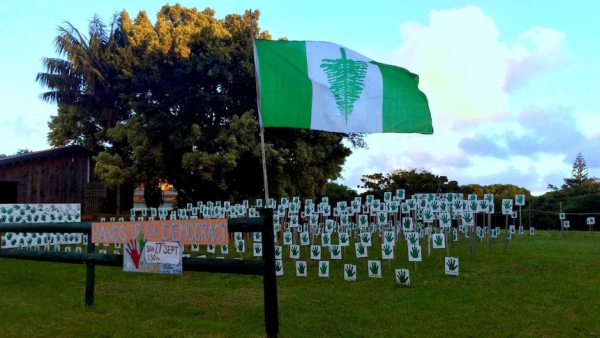
"Hands Up for Democracy" protest site, with an upside-down Norfolk Island flag as a symbol of distress, 2015. |
Sept. 27, 2015: The island sees a rare protest march through its streets, with several hundred participants - an enormous turnout for the small community of about 1,700. It is organized by Hands Up for Democracy, an organization loosely associated with NIPD, which also creates a protest installation right in the middle of Burnt Pine (the island's commercial centre), next to the main shopping mall, where it puts up hundreds of wooden signs each showing a green hand - symbolizing democratic choice - and on which a supporter's name is inscribed.
Oct. 4, 2015: Norfolk Island Time is permanently set back by half an hour (from UTC+11:30 to UTC+11) to align the island for practical purposes with Daylight Saving Time in most of Australia.
April 25, 2016: NIPD lodges a petition - delivered by international human rights lawyer Geoffrey Robertson - to the United Nations decolonization committee seeking listing as a non-self-governing territory. Lisle Snell, the last chief minister, says this would impose certain obligations on Australia. "It's a very, very historic occasion for us and we can't emphasize strongly enough the importance of this process that we are going through," he says. On April 27, protesters begin to occupy the grounds of the former Legislative Assembly - dubbed the "Tent Embassy" and kept in existence for years thereafter. They also deliver a letter to Administrator Hardgrave, asking him to leave the island, accusing him of banning criticism of Australia from Norfolk Island's radio station (e.g. the hosts of a popular satirical programme, "Very Nearly Relevant," were sacked in February). Although public opinion on the loss of autonomy is divided, NIPD represents a large section of the population.
May 9, 2016: Administrator Hardgrave is reappointed until March 2017.
July 1, 2016: Under the 2015 legislation (and the Norfolk Island Administration Bill 2016, passed by the New South Wales parliament in May 2016), Norfolk becomes a New South Wales regional council. State law of New South Wales will apply to Norfolk Island, with state-level services to be delivered to the territory by the New South Wales government. However, Norfolk Islanders will not be eligible to vote in state elections in New South Wales. Most Australian federal social security, immigration, health, and taxation arrangements will be extended to Norfolk Island, and residents are to vote in federal elections as part of an electorate within the Australian Capital Territory. Lotta Jackson (originally from Sweden), who was appointed chief executive officer on June 10, now becomes general manager. The five members of the council, elected on May 28, are Rod Buffett, Lisle Snell, Dave Porter, John McCoy, and Robin Adams. Three of them support NIPD, the group opposing the removal of autonomy; only Porter advocates a pro-Australian position, while Buffett is ambivalent. On July 6 the council holds its first meeting (in a refurbished building in Burnt Pine to which some of the furniture salvaged from the legislative chambers has been relocated) at which Adams is elected mayor and McCoy deputy mayor. One consequence of the new system is the abolition of Norfolk Island stamps; the Norfolk post office is closed down, its services now performed by Australia Post, using Australian stamps. The selling of stamps to collectors being often important for small territories, this indeed deprives the island of a significant source of revenue.
Aug. 9, 2016: Census population: 1,748 (males 818; females 930).
October 2016: Norfolk Island receives a visit from controversial Australian senator Pauline Hanson, who calls for the removal of Administrator Hardgrave.
November 2016: The federal government refuses a request by the Regional Council for A$15 million to finance a connection to the Hawaiki trans-Pacific submarine cable, which is to provide high-speed broadband to participating areas.
Dec. 16, 2016: Air New Zealand announces that it will withdraw air services from Auckland to Norfolk as of May 2017. However, a New Year's announcement by the company Norfolk Island Airlines indicates that they will be stepping into the breach.
2017: Mayor Adams repeatedly highlights the difficulties in extending New South Wales laws to Norfolk Island, advocating the modernization of the territory's existing laws to mirror those of New South Wales, rather than the direct application of New South Wales law to Norfolk Island, particularly in view of the ineligibility of Norfolk Islanders to vote in state elections. In May Fiona Nash, the minister for local government and territories, approves a framework for consultations with the Norfolk Island community on proposed legislative changes.
March 3, 2017: Eric Hutchinson is appointed as administrator, effective April 1.
March 2018: Geoffrey Robertson submits a complaint to the UN Human Rights Committee on behalf of the Norfolk Island Council of Elders, alleging that the Australian federal government has placed the islanders' culture and language at risk by revoking their right to self-govern and has thus violated the International Covenant on Civil and Political Rights. The case is formally registered by the committee in December.
December 2018: Worried about permanent damage to the island's environment, biodiversity, and agriculture, more than 100 people sign a petition for legal class action against the Australian government. The pre-2015 island government had given the utmost care to biosecurity controls and quarantine measures. However, with the closer political integration into Australia, most of these measures have become extremely relaxed.
February 2019: A Self-Governance Assessment by Carlyle Corbin, a renowned independent expert working with the UN decolonization committee, is released. He concludes that even the limited self-governing status of 1979 never fulfilled the criteria of a self-governing territory set by the United Nations because "the very governmental structures created pursuant to the 1979 act and its antecedents were subject to continuation or abolition at the whims of the plenary authority of the commonwealth government." The current "Appointed Dependency Governance" model "which has been unilaterally imposed represents a denial of the right to self-determination of the peoples of Norfolk Island."
Feb. 4, 2019: Former Australian prime minister Kevin Rudd proposes on his blog that Norfolk Island should serve as a model for bringing smaller Pacific Island states "into formal constitutional condominium" with Australia, mentioning Tuvalu, Kiribati, and Nauru.
Feb. 23, 2019: Eric Hutchinson is reappointed administrator for an additional two years.
March 31, 2019: Former administrator (1979-81) Peter Coleman dies.
Oct. 6, 2019: Norfolk Island joins New South Wales, Victoria, Tasmania, and the Australian Capital Territory in observing Daylight Saving Time for the first time (from the first Sunday in October until the first Sunday in April).
November 2019: The Australian federal government submits an official response to the UN Human Rights Committee complaint, in which it rejects the claim that the Norfolk Islanders are an indigenous people.
January 2020: Andrew Roach is appointed to succeed Lotta Jackson (who resigned effective Sept. 13, 2019) as general manager.
January 2020: Government documents released under freedom-of-information legislation reveal that during federal cabinet meetings in 1998-99, then minister of territories Alex Somlyay already suggested withdrawing self-government powers from the island, arguing that the 1979 arrangement had given islanders a wrong sense of independence. Instead, he argued, Norfolk Island needed to be kept as part of Australia at all costs, since it was a "conveniently situated Australian sovereign territory deep within Australia's sphere of influence in the Pacific" and, as such, was essential in projecting Australian military power into the region.
March 16, 2020: A state of emergency is declared (beginning March 17) and a 32-day travel ban imposed to protect the island from infection from COVID-19. Further stringent lockdown measures are introduced over the following weeks. Norfolk Island's borders remain closed to visitors until July 10, when restrictions begin to be eased for residents of Australia, who are required to obtain an entry pass prior to travel.
July 21, 2020: Elections to the Regional Council, which were scheduled to take place on September 12, are postponed until November 14 to enable an independent governance and financial audit of council operations to be undertaken (at the request of the council) prior to the polls.
Aug. 19, 2020: The Regional Council votes 3-2 to request a royal commission of inquiry to be established to "inquire into and make recommendations on options to provide for the most appropriate form of government for the non-self-governing territory of Norfolk Island that can achieve the majority support of the Norfolk Island People; and build a pathway to peace."
Oct. 30, 2020: The Australian minister responsible for Norfolk Island, Nola Marino (assistant minister for regional development and territories), announces that the elections to the Regional Council will be further delayed, until March 13, 2021, to allow the findings of the audit to be considered. The audit reports, published on Nov. 18, 2020, state that the financial position of the Regional Council has become unsustainable, partly owing to the adverse economic impact of the COVID-19 pandemic, but also to spending overruns on major projects. The reports include more than 100 recommendations to improve the operations and performance of the Regional Council.
Dec. 15, 2020: Minister Marino issues a notice of her intention to suspend the Regional Council for three months and appoint an interim administrator, citing the issues raised by the audit, which she considers evidence of a failure to comply with its legislative responsibilities. The council is invited to make submissions on its proposed suspension within 28 days, prior to a final decision being taken. Marino earlier dismissed a request from the council for support for the establishment of a royal commission to examine the most appropriate form of government for Norfolk Island that could achieve the majority support of islanders.
Dec. 17, 2020: The Territories Legislation Amendment Act 2020, which was approved by the Australian parliament earlier this month, receives royal assent. The new legislation provides for the extension to Norfolk Island of federal laws relating to broadcasting, corporations, bankruptcy, and education services for overseas students.
Feb. 3, 2021: Marino suspends the Regional Council for a period of three months and appoints Michael Colreavy as interim administrator, responsible for exercising the functions of the mayor and the councillors. A week later Marino appoints a commissioner, Carolyn McNally, to conduct a public inquiry into whether the council fulfilled its financial and asset management obligations under the Local Government Act and postpones the elections to the Regional Council scheduled for March 13 for a further year. On March 16 the suspension of the council is extended until February 2022.
June 20, 2021: An agreement is signed between the federal government and the government of Queensland under which the latter will provide state services to Norfolk Island from Jan. 1, 2022, following the expiry of the existing such arrangement with the government of New South Wales at the end of December 2021.
Aug. 10, 2021: Census population (resident): 2,188, with 25.1% identifying as having Pitcairn ancestry.
September 2021: It is reported that unhappy locals are planning to petition the Australian and U.K. parliaments for a restoration of their autonomy and are considering a government in exile. They are critical of the Australian authorities' handling of health and education services, newly imposed land rates, and the lack of consultation in the government process. Education services are to be provided by Queensland instead of New South Wales, which has provided them for nearly 100 years. For teachers, all registered in New South Wales, this raises the threat of a loss of seniority and benefits, so the majority of them are planning to resign and return to their home state. New South Wales is reportedly no longer going to provide health services but just how the gap will be filled is yet to be conveyed to the people. In October it is reported that businessman Peter Christian-Bailey is forming the Norfolk Island Party to contest the Canberra suburban seat, Bean, which includes the island.
Dec. 30, 2021: The first cases of COVID-19 on the island are recorded, weeks after the territory reopened to tourists from Queensland and New South Wales. No deaths are recorded.
February 2022: Norfolk lawyer John Brown announces an independent candidacy for the federal seat of Bean in the Australian elections of May 21. Given that Norfolk Island represents barely 1% of the Canberra-based electorate, however, he ultimately appears to decide not to register and likely lose his deposit. In the end, there is no Norfolk Island candidate on the ballot.
Dec. 27, 2022: The first cruise ship passengers since COVID-19 border closures arrive on Norfolk Island.
May 11, 2023: George Plant is appointed administrator. He is sworn in May 26, for a 3-year term beginning June 1.
August 2023: Canberra allows the setup of the Norfolk Island Governance Committee (NIGC) to repair the relationship and develop a new system for running the island. Three community representatives are elected on October 11: Alma Davidson, Chelsea Evans, and Chris Magri. Other members are the administrator, one representative from the Australian Department of Infrastructure, Transport, Regional Development, Communications and the Arts, and one representative from the Queensland government. The NIGC meets for the first time on October 18.
Nov. 13, 2024: Australia decides on "a new bespoke local governance model for Norfolk Island," with a Norfolk Island Assembly to operate on four-year terms and to comprise five elected members, including a full-time presiding officer. For the transition until the Assembly is established, the Regional Council's period of administration is extended, with Scott Mason appointed as lead administrator (effective December 6). On November 20 Alma Davidson resigns from the NIGC in protest, saying the federal government has dismissed the concerns that have been raised. She says laws will be made by ordinance, "with the new council to operate under an ordinance based on the Queensland Local Government Act," adding that the ease with which ordinances can be amended will undermine the stability of governance and further erode community trust.
Jan. 26, 2025: Former administrator (2003-07) Grant Tambling dies.
Jan. 1, 2026: In a "secession vote" organized by the Council of Elders and For The People Norfolk Island, 648 people participate and Peter Christian-Bailey is elected as "chief magistrate."
Feb. 7, 2026: A group of Norfolk Islanders sends a letter to Territories Minister Kirsty McBain seeking "clarification and reassurance" over a bizarre situation involving Leah Honeywood appearing at forums in the Pacific presenting herself as "chief magistrate" of Norfolk Island, a position she claims to hold since January 2024, distinct from Christian-Bailey's claim.
May 15, 2026: Fiona McKergow is appointed administrator, effective June 1.
Aug. 3, 2026: The Australian government announces a restoration of democracy for Norfolk Island, in line with community aspirations, by establishing a Norfolk Island Assembly, not by ordinance, but under primary legislation. The first stage is to be the election of a five-member Norfolk Island Transition Assembly, which will make recommendations over a two-year period to the Australian government on the future statutory governance framework.